Friday, January 10, 2014

Trends for 2014 and Beyond...

It's the turn of the year and the TV is full of "specials" recounting the events of 2013 - new births, famous people passing away, sports triumphs and tragedies, conflicts, other newsworthy events - and then there will be folks pondering what 2014 might hold for us all that's different from 2013. If we're honest, nobody can predict what 2014 will be like. Perhaps it will be a quiet and uneventful year, or perhaps there will be some major new conflict or natural disaster that will throw us all for a loop. Maybe aliens will contact us. OK, I'd better stop now as I'm stretching the speculation a little too far! Probably because I've watched one sci-fi movie too many.

I thought it would be interesting to ponder some possible trends in wastewater in North America for 2014. I'll likely be way off on some of these but hopefully one or two will hit the mark, so here goes with my predictions for 2014 and beyond!

1. Increased use of Envision for truly sustainable design

Released last year, the Envision evaluation scheme from the Institute for Sustainable Infrastructure (ISI), has the potential to radically shift the way we look at wastewater treatment design. In the same way that LEED caught the imagination of the building industry, I can see this really taking off over the next few years. I might be a bit biased because I'm helping to keep track of the roll out of Envision within Black & Veatch, but I really do think it will take off and most folks who know anything about it seem to hold a similar opinion.

2. Nutrient Removal becomes the norm for everyone

A couple of years ago there was a push by an environmental group to have nutrient removal included as part of the definition for "secondary treatment." Within our industry there was a strong push back and it never got anywhere. At the time I remember thinking that the main reason it failed is that they were advocating for extremely low nutrient limits near the limit of technology (like 0.1 mg/L phosphorus and 3 mg/L nitrogen or something like that - I forget the exact numbers). If, however, they'd proposed a more reasonable set of limits for basic nutrient removal, say 2 mg/L of phosphorus and 15 mg/L nitrogen, then they may have had more traction within wastewater treatment professionals in general. In 2013, WEF and the Environmental Defense Fund (EDF) started discussions on a Nutrient Roadmap, which may start to pave the way for more folks doing nutrient removal and maybe one day everyone doing it? Until then, there are plenty of regulations that will push utilities into doing it anyway, so nutrient removal will become the norm rather than the exception.

3. Increased focus on EDCs,PPPs, ECs, MCs, AC/DCs (whatever you want to call them!)

When I started work in the wastewater industry back in the early 1990's, the new hot topic was endocrine disrupting compounds (EDC). Fast forward 20 years and the new hot topic is still EDCs, though they've added some other trace organic compounds to the list and the name keeps changing! (Micro-pollutants this week maybe?). But recent pilot trials at Swiss wastewater treatment plants to put in advanced equipment to remove these nasties makes me think the focus and action on these trace contaminants will only increase.

4. Life-Cycle Thinking comes of age

I've written on life cycle assessments (LCA) in a previous blog, so I probably shouldn't keep banging on about it, but I do think that we'll see more and more use of Life-cycle thinking in our business. In fact the Envision method I mentioned already advocates LCA for assessing potential environmental benefits.

5. More resources online

Where do I start? Wefcom, WaterWiki, Waterworld, Engineers Toolbox... there's so much information on the internet focused on water and wastewater, I hardly know where to start. Maybe that's a good topic for a future blog? But for sure we'll see more and more useful information online and in electronic format.

OK, so those are my predictions for 2014. What are your predictions for 2014? How about other parts of the world?


Saturday, November 2, 2013

WEFTEC 2013 Debrief (aka the post-WEFTEC blues!)

Opening Sessions

WEFTEC 2013 came and went several weeks ago, busting all sorts of records over previous years, so I'm a little tardy in giving my impression of this year's event, but here goes anyway...

Innovation Showcase

The Good

So, what were some of the highlights for me? Here in no particular order are the things that impressed me this year:

  1. The Venue: the layout of the bookstore and global meeting center right outside the entrance; the exhibition floor right underneath the rooms for the technical sessions; posters right outside the session rooms and electronic versions showing on flat-screen TVs... even a screen for tweets! The conference center was very-nicely laid out.
  2. People: I love being able to catch up with colleagues I've not seen for some time. Though I'm a technologist at heart, as I get older (cue cheezy violin music) I appreciate reconnecting with colleagues I've not seen for a while and getting to know new colleagues. You can transfer knowledge and ideas via web-based seminars, conference calls and the like, but nothing beats meeting people face to face.
  3. Innovation Showcase: One of the few sessions I did get to attend was held at the Innovation Showcase where Yaniv Scherson presented on his CANDO process and several others presented some great and innovative ideas. There was also a session here to discuss the development of a Nutrient Roadmap, which should be pretty interesting.
  4. Workshops: I have to say I really enjoy the interactive nature of workshops versus the somewhat formal and stuffy format of technical session presentations. This year I somehow managed to help out with 3 different workshops over 2 days - sustainability, modeling and energy. I don't recommend that to anyone, but I do recommend anyone to attend workshops in the future. You learn a heck of a lot more than just watching a paper presentation.
  5. Opening sessions: I used to skip the opening sessions because I presumed they were too high level or not relevant for the kinds of things I focus on, but a couple of years back a good friend and colleague, Sudhir Murthy, encouraged me to attend an opening session and I have to say I was pretty impressed. This year's opening session and the following session by water leaders from around the world were pretty inspirational and very well done (photo at the top was the Water Leaders session).
  6. The Inaugural Bookshop Quiz! And not just because my colleagues from B&V and our client from St Cloud were the winners (see photo below). This was a bit of an experiment for WEF and by my reckoning it was an outstanding success and hope we do it again next year.
Bookshop Quiz 2014 Winners

The Not-so-good (PC term for Bad, I guess?!)

Overall WEFTEC in Chicago surpassed itself this year (are you listening New Orleans?!). So I only have a couple of nit-picky negatives that you can skip right over if you're a glass half-full kind of person (I think I'm a glass at 50% capacity person myself - figure that one out!). Here they are:

  1. Location: OK the venue is awesome, but it's too bloody far from the awesome hotels, restaurants and other delights of downtown Chicago. I hear rumours that the City has plans to build up the area around the conference center which would be great. Maybe they can add a light rail link or tram too? We stayed at the Sheraton on the north side of downtown and it was pretty cool to take the shuttle bus down some secret road under the city and down to the convention center, but I'm guessing others didn't have quite the same fun with their long queues and rush-hour bus rides back into the city.
  2. Too much to see: Maybe it's just because I'm a "Yes Man" and involved in too many things, but this year, with all the committee activities and what-not (including doing a mid-term exam - don't ask) I barely saw a handful of presentations. At some point I need to go through the proceedings and see what I missed.
  3. The submission process: This is probably a contentious one and may come across stronger than I intend, but I have issues with both the workshop submission process and the abstract submission process. The workshop submission process starts too soon (less than a month after WEFTEC), has too many steps and is contrained by an inflexible rubric that has only one format in mind. The paper abstract submission format and process used to be OK i.e. develop a 3 page Word document and a few figures. Now it's a nasty process of developing some text of indeterminate length with figures kept separate in pure graphical form, then you use some weird coding to get your figures and tables (haven't figured out a tidy way to handle tables) into the text, hopefully in the right spot. A little knowledge of html coding is helpful. Maybe this is a little unfair as it's not quite as bad as I make out as long as you know the process ahead of time. And I've never been asked to review any papers for WEFTEC so I'm hoping that maybe the new system makes the review process easier somehow.

OK, so WEFTEC 2013 is over and I'd say it was probably the best one yet. The bar is pretty high for New Orleans and WEFTEC 2014!

Friday, October 4, 2013

Heading to WEFTEC 2013

I'm currently sitting on a SouthWest Airlines flight from DC heading to Chicago for WEFTEC13 (feel like I should hashtag that somehow but I just saw Jimmy Fallon's #hashtag skit so maybe I won't!)

So what does WEFTEC have in store for us this year? I've been attending WEFTECs since 1999 and every year I'm amazed by the sheer number of papers, exhibits and interactions that go on. Some years it gets a bit overwhelming as it's impossible to see everything and meet everyone you want to catch up with. And I think I have suffered from burn-out from seeing so many conferences year after year, but this year I'm pretty impressed with some of the innovative ideas the WEFTEC organizers have come up with to keep it interesting and a bit different than previous years. Here are a few ways they've done so:

Innovation Showcase : I'm impressed with WEFTEC embracing innovation with focused events under the umbrella of the innovation showcase. They've been doing this for a few years now, I think, but this year it caught my eye and I plan to attend at least some of the events (too much stuff to see and do!)

Meet the Expert: My good friend and colleague, Dr James Barnard, and other experts will be available to answer your burning questions on nutrients and all sorts of other water topics.

The Mobile App: This is a very cool app, being easy to use and full of all the information you'll need to figure out where you need to be and when. My only criticism is that I can't export the calendar or sync with Outlook (I'm obviously too busy as Outlook rules and governs my every move it seems!).

Last, but by no means least is the Bookstore Quiz! And not just because I'm one of the judges. This should be fun so come and show your wastewater know-how with the chance to win $500.

So, I've now arrived in Chicago and I'm ready to see what WEFTEC holds. Workshops over the next couple of days and then the main events and sessions starting Monday. I look forward to seeing some of you there (especially at the quiz, OK?).


Saturday, September 21, 2013

W is for water

Last, but by no means least in our consideration of resource recovery, is Water. It seems obvious to say that the most valuable resource we can recover from waste-water is most often the water itself. In arid regions like Israel, Cyprus, Nevada and Southern California, the pressure on water resources is so great that there is little choice but to reuse the "used water" (to borrow a phrase from Singapore). In other regions, water stress is not yet a concern but it's coming as populations increase and weather patterns shift.

The topic of water reuse is huge and well-established and I don't think I could do it justice in a blog such as this. Instead, I just want to highlight a few interesting articles. The August edition of the IWA Journal, Water 21 has a nice article on global water reuse that I highly recommend. Unfortunately you have to be an IWA member to access the article, or you can buy the book on which the article was based!

The Energy-Water Nexus is a topic that's courts a lot of attention, and rightly so. Energy is a key element that drives economic development and the modern amenities the western world has come to rely on. Energy production requires a lot of water and water production and wastewater treatment require energy which links the two quite strongly. I should note that the balance in this linkage is pretty skewed toward Energy production needing a huge volume of water whereas water production and wastewater treatment requires a small piece of the energy pie! There are many, many article discussing this topic. Here's one for starters.

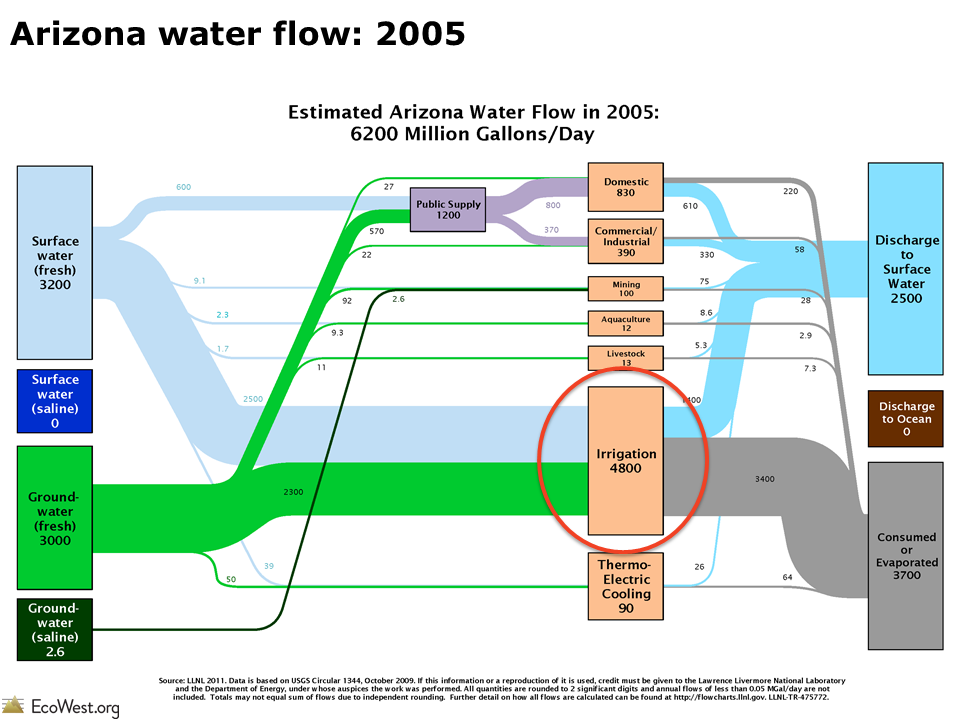
Extending this topic a little further, we need to think about the other activity that uses a huge quantity of water, and that's agriculture. I'm not a water resources guy (poop engineer remember!) so it was really enlightening to see the water source and use diagrams for the US. The amount we use and produce for domestic use is tiny in comparison to irrigation and energy production. Ecowest has an informative presentation that describes some figures produced by the Lawrence Livermore National, in their case focusing on the western states of the US.

So, where does this leave us in thinking about water reclamation and resource recovery? Certainly it's a topic that is region specific. If you have an abundance of water and sources of a high quality, then it makes most sense to treat our wastewater and return it to the natural environment to help preserve our rivers and waterways as we've traditionally done it treatment plants for years. But in regions where there's a shortage of water we need to see our wastewater streams as valuable sources for reclamation and reuse. I like to think of it in a wider context of reduce-reuse-recycle. First of all, let's use whatever measures we can to conserve and not waste the water - in our homes, industries, agriculture and energy prodcution. Then let's look for ways of reusing water within these different arenas. Then finally we look at treating and recycling the used water at our wastewater treatment plants.

As I said, this is a huge topic and way beyond the scope of a little blog like this. But hopefully I've helped you to stop and think about the part that wastewater treatment facilities can play in our regional water cycles and to see the value of our most precious resource of all: water.


Sunday, September 1, 2013

Energy Info

I thought about giving this blog a corny name like "Sourcing Energy Info" but on seconds thoughts that might be too confusing! Before I turn my attention to the "W" in resorurce recovery, I wanted to wrap up the discussion of Energy by passing on a few of my favorite websites on the topic. Not the most riveting of blogs for sure, but I want my blogs to contain useful information through the links and not just be this crazy limey blathering on about his latest beef or pet project! So here are a few sites I've found in the mass of information on the glorious mess that is the world-wide-web (do we still call it that, or am I showing my age already?).

U.S. Energy Information Administration (www.eia.gov)

This one has to be the top of the pile for any data junkies like me. They have historical data for every energy source by state, end use and major energy provider. If you want to know the $/kWh for electricity or $/btu for natural gas, and heaven knows what other pricing or production stats, this is the place to start. Although focused on US pricing, they have some good International stuff and their Energy Outlook takes a shot at trying to guesstimate future energy costs. A warning to data junkies though, you may find yourselves lost in piles of data for days on end so have a friend feed your cat whilst you're using it!

U.S. EPA (www.epa.gov or water.epa.gov)

The EPA website has to be one of the most data-rich but frustrating sites I've used over the years. They have a huge amount of information - data, electronic documents, maps - but it can be tough to dig into it to find any of the useful stuff. Thankfully their search is pretty good and so you can usually find what you're looking for after a while. On the topic of energy in wastewater treatment facilities, I recommend starting with: http://water.epa.gov/infrastructure/sustain/energyefficiency.cfm as the front door to a lot of general information to help folks to be more energy efficient. Another good spot to look is the Energy Star site which includes a section for wastewater treatment (which, ironically, I can no longer find!!!). Portfolio manager is the closest thing to a national standard for assessing energy efficiency at a treatment facility. I'm not a big fan of their regression analysis for the scoring (maybe a topic for a future blog!) but as a tool for assessing energy performance and planning improvements it's pretty decent.

The Ecoinvent Database (www.ecoinvent.ch)

In a previous blog I spoke about Life Cycle Assessment (LCA) as a powerful tool for assessing the environmental impact of processes and products. A huge piece in the LCA puzzle is energy use and so the LCA databases are a great source for understanding how such diverse things as chemical use or driving to/from the treatment plant are tied to global energy use. As noted in that article, I access the databases through the Simapro simulator.

Water Environment Research Foundation (www.werf.org)

My last blog focussed heavily on the work being done by WERF, so I won't go on about it agian, except to point you toward their Energy Knowledge Area: http://www.werf.org/i/ka/Energy/a/ka/Energy.aspx (hmmm, you'd think we could have a shorter URL...)

Wikipedia (www.wikipedia.org)

"Really Andy, you're suggesting Wikipedia as a useful reference? It's not peer reviewed and there's also sorts of mis-information on there." Well, I have to confess to being a big fan of Wikipedia. If you need a basic overview of any topic such as what the heck is a Carnot cycle or a Rankine Engine, I can't think of a better place to start than Wikipedia. Usually you get a nice and succinct definition in a paragraph or two and a link to sites with more depth and then some reasonable references at the end if you want to chase more information. I've heard the criticism that it's not peer reviewed and may be full of errors, but I've seen errors in books and supposedly peer-reviewed papers. Many text books and most papers have a myopic view of topics that is put to shame by the consensus approach of Wikipedia. If I ever get to the point of being a prof in a University I'll tell my students to use Wikipedia and other web-based resources instead of text books as much as possible. (Come on, tell me I'm crazy!)

So, there are a handful of sites to get you started in your investigations into Energy and wastewater treatment. I'd be interested in hearing from others on useful sites you've found so please comment below!


Saturday, August 24, 2013

E is for Energy

In my past few blogs I discussed nutrients as the "N" in the context of the "N-E-W" paradigm for wastewater treatment (rebranded as "water resource recovery facilities" but it's taking me time to adjust so bear with me, please!). In this blog we turn our attention to Energy (that's a capital "E"!)

Energy is currently the hottest topic in our triumvirate of resources that we can recover at water resource recovery facilities (there, I said it) aka poop plants (sorry, couldn't resist!). I think this is due to the fact that we pay our electricity and gas bills and so we're conscious of the cost of energy. Of all resources, we relate to energy the most because we can link it back to the dollars and cents used to pay for it. Another way of saying the same thing is that ecologically minded people can think of energy recovery in terms of reducing carbon footprint and at the same time the more financially motived people can see the possibility for cost savings. In sustainability terms, this is a real "win-win" ( or "win-win-win" if we can rope in social benefits somehow in the triple bottom line) which overcomes the need to consider trade-offs between reducing environmental impacts and the financial cost. I think this is OK, and certainly makes it easier to make the decision to implement an energy project at a facility, but we need to be careful not to expect the "win-win" for all sustainability projects and we need to set expectations that not all energy and sustainability projects will have a short-term financial pay back. If it does, great, but that's not the only reason to do the project.

In thinking about energy neutrality, which is a goal for WERF and others, we need to think about it from both energy use (the "demand" side) and energy as a resource (the "supply side"). It makes no sense to produce lots of electricity on site and at the same time be running inefficient pumps and blowers. We really do need to think about energy as a whole. That's the focus for a WERF research project I'm helping on right now called "Energy Balance and Reduction Opportunities, Case Studies of Energy-Neutral Wastewater Facilities and Triple Bottom Line (TBL) Research Planning Support" (a bit of a mouthful but descriptive).

I encourage everyone to take a look at what WERF is doing in Energy recovery as well as other organizations. Feel free to post a reply to this blog if you know of other noteworthy activities in energy recovery for wastewater treatment plants... I mean water resource recovery facilities!


Friday, August 2, 2013

Nutrients Part 2

Vancouver
Vancouver

My original plan was to step from Nutrients to Energy to Water week by week in thinking through resource recovery from wastewater treatment plants, but I want to dwell a little longer on Nutrients as this past week I attended the WEF/IWA Nutrient Removal and Recovery 2013: Trends in Resource Recovery and UseIt was a very good conference. Just the fact that this annual conference that started out looking at nutrient removal now includes significant space for recovery of said nutrients is an excellent step forward. Last Blog I listed what I thought were 3 significant hurdles to nutrient recovery, namely Money, Focus and Knowledge. This past week certainly brought Focus to the topic and considerable Knowledge too... to be honest there was so much knowledge shared I need to go back through the proceedings to see what I missed! This is excellent news in our move toward a sustainable future.

So that's the good news, but still there is the significant hurdle of Money. I want to offer the suggestion that we need to broaden our perspectives when it comes to looking at the finances of nutrient recovery projects. One very obvious example is the benefit that comes from removing phosphorus from a treatment facility that is suffering from pipe blockages and equipment failure due to struvite. I have heard of a couple of utilities that have decided to do phosphorus recovery in order to remove phosphate from their sludge liquors where struvite was a major problem. There is also evidence that sludges rich in phosphorus (due to enhanced biological phosphorus removal) are more difficult to dewater. Finally, the content of P in most biosolids produced in a treatment facility is much higher than it needs to be for agronomic use. Connect all of these factors together, estimate the cost benefits of them and then add this to the economic analysis for P-recovery and it will significantly shift the balance.

And all this is can be acheived without considering the true value of phosphorus as a non-renewable resource. Throw in this factor, and the fact that it's doing the right thing, then I think the case for nutrient recovery is much stronger than many may realize. I'm excitied to be working on a P-recovery project at Stickney in Chicago over the next several months. I strongly encourage others to consider doing it - the financial aspects are much better than you'd expect if you take an holistic view, and it's just the right thing to do, so do it!