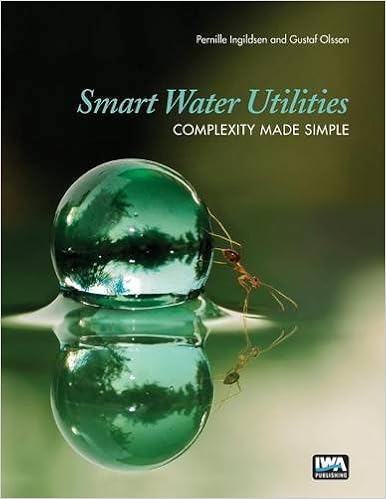
For the breakfast meeting I persuaded my colleagues to take their lead from a recent book produced by Pernille Ingildsen and Gustaf Olsson, called "Smart Utilities: Complexity Made Simple". Their excellent book uses a very simple but useful mnemonic to help us get our minds our the most important aspects of instrumentation and control in the water industry. Quite simply it is M.A.D.!
Friday, September 9, 2016
Get M.A.D. to be smart!
For the breakfast meeting I persuaded my colleagues to take their lead from a recent book produced by Pernille Ingildsen and Gustaf Olsson, called "Smart Utilities: Complexity Made Simple". Their excellent book uses a very simple but useful mnemonic to help us get our minds our the most important aspects of instrumentation and control in the water industry. Quite simply it is M.A.D.!
Wednesday, March 9, 2016
Model-ing Citizens
In thinking about the seminar, I started to reflect on the fact that there are a lot of good wastewater process simulators on the market right now, 4 of which I'll talk about in this blog. Before I get to them though, I have to comment on the fact that there are so many simulators in what is a pretty niche market. If I think back to spreadsheets in the 1980s' there were several on the market - Lotus 123, Excel and Quattro Pro (the last being my fave for some time), but today the market is dominated by Excel alone (OK, there are a few diehards using OpenOffice, Numbers on the Mac or Google Sheets for simple collaborative tasks). So how come there are so many good wastewater process simulators on the market right now? I'd like to suggest a few possible reasons:
- Wastewater treatment is complex (and fascinating!) and so we need models to help us figure it out.
- Wastewater modeling has strong "champions" who have really driven the ideas and industry in a positive direction. In another blog I might list out several of these individuals, but from my own personal experience and because he's turning 60 soon I'll just mention Imre Takacs here. Super nice fella with a real passion for modeling, including his latest venture with SUMO.
- Wastewater modeling is cool. Let's face it, producing diurnal graphs and "playing" with a virtual plant is way cool. That's why I like it, right?
Simulators
GPS-X
BioWin
SUMO
SIMBA#
Monday, January 4, 2016
Bad data versus big data (or big bad data!!)
Over the years I've been involved with various projects and discussions on generating and handling data in wastewater treatment. A few years ago I was involved in a couple of WERF Projects focused on developing Decision Support Systems (DSS) to prevent plant upsets, along with Dr Nancy Love and Advanced Data Mining (ADMi). The folks at ADMi did some nice data analytics to pick out anomalies that might indicate toxins in the plant influent, but one of the major hurdles we ran into was distinguishing anomalies due to toxins and anomalies due to measurement problems. This reminded me of what my ex-boss and mentor, Dr John Watts, used to drill into me which is you need to focus on good primary measurements in order to have confidence in your data. Wastewater is a tough place to try to do that! As I said, a lot of our data is bad.
So, here is my brain dump on some of the keys to making big data work in wastewater, and avoiding the pitfalls of bad big data (there's a tongue-twister there somewhere...)!
5 keys to making big data work
1. Focus on data quality rather than quantity
- Clean them - wastewater is an extremely fouling environment an not the best place to put scientific equipment. My experience has been that everyone underestimates how quickly sensors become fouled. Go for auto-cleaning whenever possible and avoid installing anything in raw sewage or primary effluent unless you really need the measurement (see Key #2!) as these areas are particularly prone to fouling. Mixed liquor is actually an easier place to take measurements and final effluent the easiest of all!
- Calibrate them - this is generally understood, though the frequency of calibration, particularly for sensors that tend to drift, is generally shorter than ideal.
- Validate them - this is the piece that's overlooked by most instrumentation suppliers, I think. Analytics to validate the measurements, particularly during calibration is an area that needs much more attention.
2. Measure what matters most
3. Think dynamics, not steady state
![]() |
| Graphic showing difference between composite sample and continuous measurement (Courtesy Dr. Leiv Rieger/WEF, taken from WEF Modeling 101 Webcast) |
4. Recognize different timescales

- Diurnal (daily) variations
- Weekly trends (especially weekend versus weekday differences)
- Seasonal shifts
5. Consider how to handle outliers and extraordinary events
Wednesday, September 16, 2015
A Blog on Vlogs!
WaterWorldTV
In terms of water/wastewater news and professional interviews, Angela Godwin at Water World does a great job. She goes to the major conferences like WEFTEC and ACE in addition to doing a regular video segment for their website. In fact here are a couple of interviews of a couple of my colleagues:My boss, Cindy Wallis-Lage, being interviewed at the recent ACE conference this year...
Water Sifu
OK this is a water vlog, not poop treatment, but I love this for Ty Whitman's style and it is worth watching for the theme music alone! Very cool. Here's a vlog on breakpoint chlorination (hey, that's relevant for wastewater treatment!)The Rural Community Assistance Partnership
This You Tube channel has a bunch of useful educational-type videos on various aspects of water and wastewater treatment (other things too, maybe???). I'm not sure it's strictly speaking a "vlog" but I like their informal style so it's close enough! Here's one on energy efficiency at a poop plant...WEF Webcasts
Hmmm, now I'm really stretching it by claiming that a webcast, webinar or webinamathingy (what is the proper name?) is some kind of vlog, but hey, WEF has some cool information in their webcasts. OK it's not a vlog, but here is one I was involved in on modeling.http://www.wef.org/Modeling201/ oh wait, it seems you have to be a WEF member now to view it. Ah well. OK so here are some other WEF videos, mostly of things from the annual conference WEFTEC but there are some other interesting videos too:
https://www.youtube.com/user/WaterEnvironmentFed
WERF
OK, now I may be stretching it to say WERF has vlogs but they do have some neat videos on various topics. I like this recent one on their LIFT program (along with WEF), focused on Mango Materials. It feels like a vlog even if it isn't one!So, there are some pretty neat videos out there but no a whole lot of poop-focused vlogs, per se. So maybe there is room for the Poop Engineer to try moving pictures!
Saturday, July 25, 2015
My Journey Into Sustainability
A Personal Journey into Sustainability
A few days ago I was asked to speak at a local APWA luncheon on the topic of Envision. I usually do pretty technical talks but on this occasion I thought I'd try something different and make it a little more personal by describing my own journey into sustainability as a lead-in to giving an update on Envision itself. The Prezi below shows the gist of the talk - so go ahead and click through it - but without my narrative it's not really informative, so I thought I'd add some notes below that map out my journey!Loughborough
I did my bachelor's degree at Loughborough University of Technology (if you need help pronouncing it click here: Loughborough !). At the time I was an idealist who wanted to change the world to make it a better place. I decided to do chemical engineering because I was good at maths, chemistry and physics, but I selected a degree with the long title of "Chemical Engineering with Environmental Protection" because I thought I would be able to somehow stop all those nasty chemical factories from hurting the environment! As it happened, I ended up doing a year's internship with Severn Trent Water running pilot poop plants for their R&D group and so my glorious love for poop plants and wastewater engineering began!Western Australia
Fast forward 15 years and I was by then working for Black & Veatch, based in our Kansas City office. (Actually we were stuck in the basement of our Overland Park HQ at the time, but that's another story!) Then I got the opportunity to move to Perth, Western Australia for 18 months working on their 3 largest wastewater treatment plants. It was an excellent experience all round but in particular I got to experience 3 things: wonderful espresso coffee (I know! who'd have thought?), awesome food (but generally crappy service!), and... sustainability. The last one was taught to me by Susanne Cooper, who is a senior manager for Sustainability at SKM, the firm we teamed with on the program in Perth. She has such a passion for sustainability that it's infectious and it really resonated with me. I'm still very thankful for the way she opened my eyes and passed on that passion to me.Back in the USA
Envision
And so, recognizing that it's tricky to come up with a simple way to measure sustainability, the clever folks at the Institute for Sustainable Infrastructure came up with a great assessment tool called Envision. What is Envision? Check out this factsheet. Why use Envision? Here's my list of reasons:- It's a real "standard" endorsed by three major national organizations: APWA, ASCE and ACEC.
- If everyone uses the same approach it facilitates clarity in communication. Some requests for proposals (RFP) that I've seen for infrastructure projects have been vague on their requirements for sustainability or prescribe you use their specific approach which others may not know. Picking a standard tool like Envision makes it easier to specify and respond to sustainability requirements in proposals.
- It's open and transparent. The guidelines are well written and honest. There's also a genuine openness at ISI for feedback to make this a system that will work. The ultimate goal of ISI is truly to drive sustainability into our designs. I give credit for this to Bill Bertera, who's doing an excellent job guiding ISI.
- Its web-based, so it's easy to access
- The tools are user-friendly
- And finally, for all Apple product users... it's cool (or great!) So use it!
So, at the end of my presentation I can honestly say that 20 years on the idealistic young engineer from Loughborough University who wanted to change the world is more optimistic than ever that maybe we can change the world for the better and Envision is a great tool to help us do that. Will you do the same?
Friday, April 17, 2015
Leading Edge or Bleeding Edge? (Reflecting on Innovation)
Over the next few weeks I'll be working on an article focused on innovation in wastewater treatment. It really is an exciting time to be a poop engineer as there are several potentially game-changing processes and technologies emerging on the scene: anammox, granular activated sludge, primary DAF, thermal hydrolysis, struvite recovery, to name but a few. Add to this initiatives like LIFT and Isle Utilities TAGs that are pushing these new ideas to the fore. Finally there is Envision that enables us to evaluate the sustainability of these new ideas. As I said, it is an exciting time to be a poop engineer, indeed!
But that's not the focus of this blog; well not exactly. A few years ago I was involved in evaluating, piloting and designing what was then a pretty innovative process called the "integrated fixed-film activated sludge" or IFAS. At that time one of my colleagues said something that has stuck with me ever since:
"we want to be leading edge, but not bleeding edge" (I wish I could remember who said it first so I can give them credit, but I've heard several of my colleagues use it since and I overuse it!).
What is meant by that expression is reasonably self-event. We want to be using new ideas and pushing the envelope of improvement, but not just for the sake of doing new stuff. We want to be innovating but not just for the sake of innovation. Some ideas are ready for implementation but some need the kinks working out still and yet others may be cool but really don't offer tangible benefits over established technologies.
Another thought I want to bring to the discussion in this blog (hoping to make it a conversation!) is the "S-curve of technology implementation." This curve has been discussed widely of late amongst wastewater professionals and indeed I'll probably include it in my journal article. The discussion has mostly been focused on how can we accelerate technology adoption up the curve and/or help folks to jump across the "chasm of risk" between the pilot and full-scale. Getting the first installation of a technology or process idea is key in this. That's the main focus of LIFT and a noble one too. Let's go for it! Woo-hoo!
But... wait a minute. Take a breath. In our exhuberance for new technology I want to discuss another curve for just a moment. The technology hype cycle. I think it's a relatively new concept and is applicable to the drive to push new technologies to sell to consumers - think Video2000, think Bluetooth, think 3D TV, think the internet of everything (oooh, risky) - there are all sorts of technolgical ideas that are pushed out and hyped up that in the end don't amount to what was originally promised.
In our enthusiasm to advance innovation, are we in danger of just innovating for the sake of innovating? Are we pushing for bleeding edge and shifting from the S-curve to a hype curve? What do you think? I'm purposely putting this in a blog for open discussion so I can be accused of being a luddite or worse in the relatively quiet and safe setting of blogger (really, does anyone actually read my blogs?!). If we can discuss it here, then I'm hoping to bring some of those thoughts to the journal article in a less provocative way!
The last thing I want to do is stifle enthusiam for innovation, but equally I've seen a couple of ideas in wastewater treatment "oversold" in the past few years and then die on the vine. There was a sludge reduction technology called "Cannibal" that seemed promising and almost too good to be true. Turns out it was too good to be true for many applications, but still it's a good fit if the wastewater characteristics are right and the plant constraints dictate. Unfortunately the hype killed the idea for a lot of people... but, look at the hype curve, after the hype bump there's a drop and then a steady improvement in technology. I see a similar thing as a result of Cannibal. It certainly didn't live up to the hype, but now people are looking more closely at the cellulose material in wastewater and thinking about how we handle it (think toilet paper!). Some good came out of the hype as it drove further investigations and discussion. That's great for the industry, but maybe not so good for those bleeding out because of the hype.
My concern is that we may be doing similar things with other great ideas. Mainstream deammonification is a great concept, but in many instances it doesn't make sense. Granular AS is very cool, but again it probably won't fit all situations. I'm an advocate for struvite recovery, but it doesn't fit all faciities. Let's not hype these ideas, but let's evaluate where they fit best to play to their strengths...
Alternatively, maybe we do push on to the hype curve, bleed a little and then learn something for the next technological advancement?
What do you think?
Saturday, October 25, 2014
Reflecting on SIWW2014 and Nepal2014
This summer I went to my first Singapore International Water Week (SIWW for those in the know). It was an excellent experience and thought I'd reflect on what I'd seen.
If I had to sum up what SIWW is all about, I'd say it was a truly global center for water professionals to network. I've been to other international conferences that do a decent job of connecting utilities, and/or consultants; others do a great job of connecting researchers and academics; still others connect regulators and policy makers... now SIWW somehow manages to bring all of them together. That's quite an acheivement. I'm a process engineer, which means I appreciate technologies and how we apply them to solve water issues. Until recently I've not really appreciated the value of networking with diverse water experts from around the world, but more and more I understand the axiom "it's who you know, not what you know." Of course it's nice to know a bit too and by rubbing shoulders with smart international experts you get to add to your own knowledge.
Fast forward to October 2014 and I'm about to head off to the IWA Specialist Conference "Sustainable Wastewater Treatment and Resource Recovery" in Nepal. I'm intrigued to see the diversity of water professionals at this conference in comparison to SIWW. In addition to diversity across the various roles in the water industry, I'll be interested to see a greater diversity across geopolitical boundaries which will help us to see the differences and commonalities across our profession. I've only worked in already-developed nations and seen wastewater treatment through the narrow lense of technologically intensive and centralized approaches. It will be good to take a step back and out to see how different nations are tackling wastewater treatment. There's a distinct possibility that other nations, still developing their infrastructure, can by-pass some of the mistakes we've taken in the West and jump ahead to more sustainable solutions directly. That's what I'm hoping for in the discussion segments of a workshop I'm helping to lead: "Workshop D: Leapfrogging to off- the- grid biological nutrient removal (October 27, 2014)". We'll see. Should be interesting...


